What Is a Bike Chain Master Link?

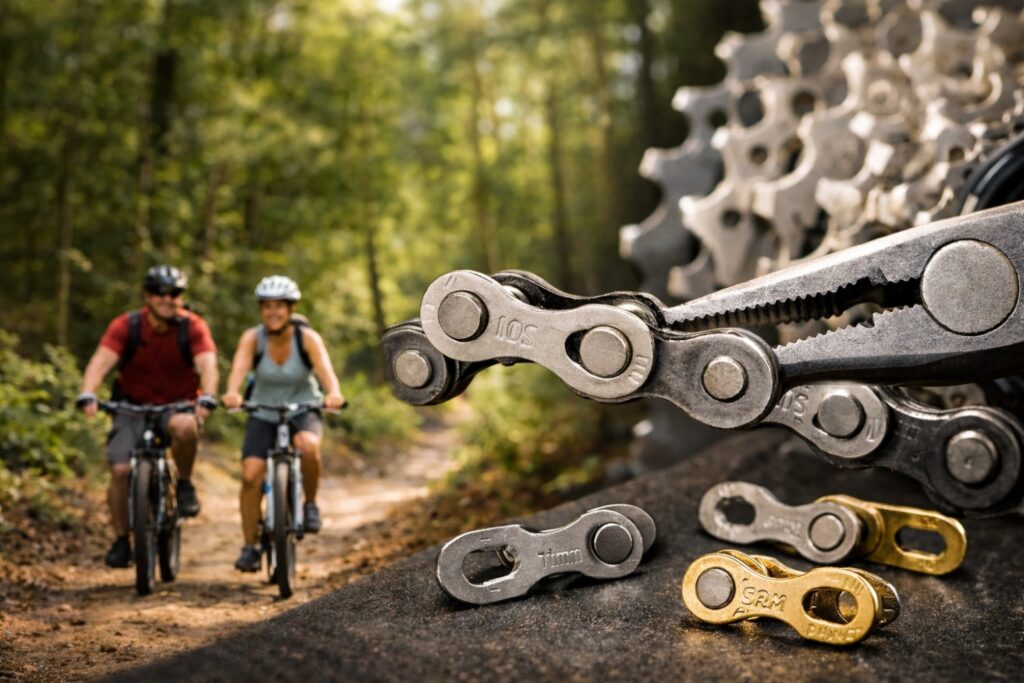
A bike chain master link is a special connecting link designed to be opened and closed by hand or with minimal tools, allowing you to remove your chain without using a chain breaker to push pins out of standard links.
The master link consists of two outer plates with pins attached. These pins slide through the chain rollers and lock into place when you tension the chain. To remove the chain, you squeeze the plates together to unlock them, then slide the link apart. To reinstall, you do the reverse: slide the pins through the rollers, then pull the chain tight to lock the plates.
Master links go by different brand names depending on the manufacturer. Shimano calls theirs a “quick link,” SRAM calls theirs a “PowerLink,” KMC uses “Missing Link,” and Wippermann calls theirs “ConnexLink.” They all work on the same basic principle, though the specific design details vary.
The advantage of a master link becomes obvious the first time you need to remove your chain. Without one, you need a chain tool to push a pin partway out of a link, remove the chain, then push the pin back in when reinstalling.
This works, but it’s fiddly, time-consuming, and weakens the link you’ve worked on. With a master link, the whole process takes about thirty seconds and requires no tools beyond your hands or a pair of pliers.
I keep master links on all my bikes now. The convenience for cleaning chains or replacing worn components is worth the minimal cost and installation effort.
DIY & General Cycling Advice Note
This article may share a do-it-yourself project or general cycling information for educational purposes. Cycling activities, equipment use, and bicycle modifications involve inherent risks.
If you choose to follow or apply any information discussed here, you do so at your own discretion and responsibility.
Always use appropriate tools and safety gear, follow manufacturer guidelines, inspect equipment regularly, and discontinue use if you notice damage or unsafe behavior.
When in doubt, consult a qualified bike mechanic or cycling professional.
Which Bikes Come With Master Links?
Whether your bike came with a master link depends primarily on when it was manufactured and what type of drivetrain it uses.
Modern derailleur bikes built in the last ten years increasingly come with master links as standard equipment. Most quality bike manufacturers now include them on road bikes, mountain bikes, gravel bikes, and commuter bikes with derailleur systems. This is a welcome change from older practice when master links were less common.
Single-speed and fixed-gear bikes often use chains with master links because these simpler drivetrains don’t put as much stress on the connection. The master link design works particularly well for these applications.
BMX bikes typically use master links as standard equipment since these chains need frequent removal for cleaning and the simpler single-speed drivetrain is compatible with master link strength characteristics.
Internal gear hub bikes may or may not have master links depending on the manufacturer and model. Check your specific bike to know for certain.
Older bikes built before master links became standard often don’t have them. If you’ve got a bike that’s ten or fifteen years old, there’s a reasonable chance it doesn’t have a master link unless someone added one during a chain replacement.
High-end racing bikes historically didn’t use master links because there was concern about the added weight and potential strength compromise. This has changed as master link technology improved, and many racing bikes now come with them. However, some riders still prefer standard chains without master links for competitive use.
The practical reality is that you can add a master link to almost any derailleur chain if your bike doesn’t have one. The only requirement is matching the master link to your chain width (6-speed through 12-speed chains all require different master link sizes because the chains are different widths).
How to Locate Your Master Link
If your bike has a master link, finding it is usually straightforward but sometimes requires careful inspection.
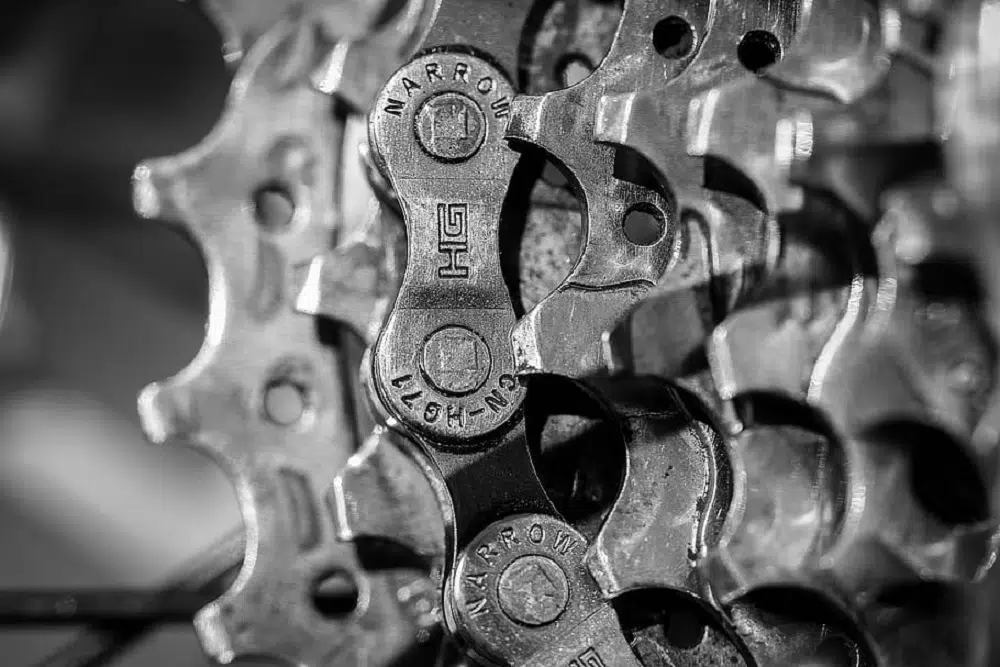
Visual difference is the most obvious identifying feature. Master links are typically made from a slightly different material than the rest of the chain or have a different finish. They’ll often look shinier, or a different color, or have a distinct surface texture compared to standard links. This makes them stand out when you’re looking at the chain.
My commuter bike has a KMC chain with a gold-colored master link that’s immediately obvious against the silver-gray of the rest of the chain. My older mountain bike has a Shimano quick link that’s just slightly shinier than the surrounding links but still clearly visible once you know what you’re looking for.
Link plate shape provides another identifying feature. Master link outer plates are shaped differently than standard link plates. They typically have small cutouts or notches near the holes where the pins go through. These cutouts are part of the locking mechanism that keeps the master link together under tension.
Plate markings sometimes include the manufacturer’s name or logo stamped into the outer plates. If you see text or symbols on a link, that’s likely your master link.
Systematic inspection works if visual identification isn’t obvious. Start at the rear derailleur and slowly work your way around the chain, examining each link carefully. Rotate the cranks backward slowly to bring each section of chain into view. The master link will eventually come around.
This process takes a few minutes but ensures you don’t miss it. I’ve spent more time than I care to admit searching for master links on bikes where the visual difference was subtle, but systematic inspection always finds it eventually.
If you can’t find it, your bike probably doesn’t have a master link. This isn’t the end of the world. You can still remove your chain with a chain tool, or you can add a master link the next time you replace your chain.
Using a Master Link to Remove Your Chain
Once you’ve located your master link, removing the chain is straightforward.
Position the master link where you can access it easily. I usually position it on the top run of the chain between the front chainring and rear cassette where there’s good working space and visibility.
Release tension on the chain by shifting to the smallest chainring and smallest rear cog. This gives you maximum slack in the chain, making the master link easier to manipulate.
Squeeze the link plates together using your fingers, or master link pliers if you have them, or needle-nose pliers if you don’t. You’re trying to push the two plates toward each other to disengage the locking mechanism.
The exact technique depends on the master link design. Most require squeezing the plates toward each other while simultaneously pulling them in opposite directions along the chain. It’s a squeeze-and-pull motion that takes some practice to get the feel for.
Slide the link apart once it unlocks. The pins should slide out of the rollers easily at this point. If they don’t slide out easily, you haven’t fully disengaged the locking mechanism yet, so go back to squeezing and adjusting your grip.
Remove the chain from the bike once the master link is separated. You now have full access to clean the chain thoroughly, replace it if it’s worn, or work on other drivetrain components.
Reinstallation reverses the process. Slide the master link pins through the appropriate rollers, make sure the link plates are properly positioned, then pull the chain tight by hand or by pushing down on the pedals. The tension will lock the master link into place.
I typically pull the chain tight by hand first to make sure everything’s aligned properly, then rotate the cranks forward under moderate pressure to fully seat the master link. You’ll usually hear or feel a subtle click when it locks properly.
The whole process, once you’ve done it a few times, takes less than a minute. It’s dramatically faster and easier than using a chain tool to break and reconnect a standard link.
Breaking a Chain Without a Master Link
If your bike doesn’t have a master link, you’ll need a chain tool to remove the chain. This is more involved but not particularly difficult once you understand the process.
Get a chain tool first. These are inexpensive (usually $10-20 for a basic model) and essential for working on chains without master links. Every cyclist who does their own maintenance should own one.
Position the chain in the chain tool so the pin you want to remove is aligned with the tool’s driving pin. Make sure the chain sits properly in the tool’s cradle, as misalignment can damage the chain or the tool.
Drive the pin partway out by turning the tool’s handle to push the driving pin against the chain pin. You want to push the pin almost all the way through the outer plate but not completely out. If you push it all the way out, it can be difficult to reinstall properly.
This is where experience matters. The first few times you use a chain tool, it’s easy to push too far and drive the pin completely out. Once you’ve done it a few times, you develop a feel for when to stop.
Separate the chain by flexing it to pop the partially removed pin out of the inner link plate. The chain should come apart at this point with minimal force.
Reinstallation requires carefully aligning the link, inserting the pin back through both outer plates and the inner link, then using the chain tool to push the pin back to its original position. This is fiddlier than using a master link and requires attention to get the pin positioned correctly.
Check the repaired link by flexing the chain at that point to make sure it moves freely. Sometimes the link will be slightly stiff after reinstalling the pin, which you can fix by flexing the chain sideways gently to free it up.
The main disadvantage of this method compared to a master link is that repeatedly removing and reinstalling pins weakens them. Each time you work a pin out and back in, you compromise its strength slightly. This is why master links are superior for chains that need frequent removal.
Adding a Master Link to Your Chain
If your bike doesn’t have a master link and you’d like to add one, the process is straightforward.
Purchase the correct master link for your chain. Master links are speed-specific, meaning you need a 10-speed master link for a 10-speed chain, an 11-speed master link for an 11-speed chain, and so on. The chain width varies by speed, and the master link must match. Check your chain or drivetrain specifications before ordering.
I’ve made the mistake of ordering the wrong width master link before. It won’t work properly if the width doesn’t match, so pay attention to this detail.
Choose the right brand if possible. While most master links are compatible across chain brands at the same speed, using a master link from the same manufacturer as your chain ensures the best fit and performance. A Shimano quick link works best with Shimano chains, a SRAM PowerLink with SRAM chains, and so on.
Remove an existing link using a chain tool to make room for the master link. The master link replaces a standard link, so you need to break the chain at one point to install it.
Install the master link by threading the pins through the chain rollers where you removed the old link, then pulling the chain tight to lock it in place. This is identical to reinstalling a chain with an existing master link.
Check chain length after installation. Removing a standard link and replacing it with a master link shouldn’t change the chain length noticeably, but it’s worth verifying that your derailleur still functions correctly across all gear combinations.
The cost of a master link is typically $5-10, which is a small investment for the convenience it provides over the life of that chain.
Common Questions About Master Links
Can I reuse a master link? This depends on the manufacturer and design. Some master links, particularly older designs and some inexpensive models, are single-use and should be replaced each time you remove the chain. Other master links, particularly higher-end models from manufacturers like KMC and Wippermann, are designed for multiple uses.
The safest approach is checking the manufacturer’s specifications for your specific master link. When in doubt, replace it. Master links are inexpensive enough that it’s not worth risking chain failure over reusing a single-use design.
Is a master link as strong as a standard link? Quality master links are as strong as standard chain links when properly installed. Early master link designs had some reliability concerns, which is why they weren’t universally adopted immediately. Modern master links have addressed these issues and are perfectly reliable for normal riding.
That said, some professional mechanics still prefer standard chains without master links for racing applications where maximum reliability under extreme stress is required. For commuting, recreational riding, and even serious amateur racing, master links are fine.
Can I use multiple master links in one chain? You can, but you shouldn’t. Each master link represents a potential weak point in the chain. While one master link is fine, having two or more in the same chain increases the likelihood of problems. If you’ve had to use multiple master links to repair a chain in an emergency, replace the entire chain at your next opportunity.
I once saw someone running a chain with three master links after repeated breakages. That chain was a disaster waiting to happen, and it finally failed completely during a ride. Don’t do this.
What if my master link won’t stay closed? This usually indicates either a worn master link that needs replacement, incorrect installation, or a master link that doesn’t match your chain width. Check that you’re using the correct master link for your chain, make sure it’s fully seated and locked, and replace it if it’s worn or damaged.
Master Links Allow Quick Chain Removal
Understanding bike chain master links and whether your bike has one makes chain maintenance significantly easier. Master links allow quick chain removal for cleaning, inspection, or replacement without the hassle of using a chain tool to drive pins in and out.
Most modern bikes come with master links as standard equipment, but older bikes often don’t. If yours doesn’t have one, adding a master link is straightforward and worth doing. The small investment of time and money pays off every time you need to work on your chain.
I’ve maintained bikes with and without master links for years now, and I strongly prefer having them. The convenience factor is substantial, and the reliability of modern master links makes them a no-brainer for most riding applications.
If you’re new to bike maintenance, learning to locate and use your master link is a good early skill to develop. It’s simple enough that you can’t damage anything if you’re careful, and it opens up the possibility of doing your own chain cleaning and replacement rather than paying a shop for basic maintenance.
Take a few minutes to check whether your bike has a master link, and if it does, practice removing and reinstalling your chain a few times. You’ll thank yourself the next time your chain needs attention.
FAQs Bike Chain Master Link
Question: Do all modern bike chains have master links?
Short answer: No, but most bikes built in the last decade come with master links as standard equipment.
Expanded answer: Modern bikes increasingly include master links, particularly quality bikes from major manufacturers. However, not all bikes have them, especially older models, some budget bikes, or bikes where the chain has been replaced with a standard chain without a master link.
Single-speed bikes and BMX bikes almost always have master links, while derailleur bikes are more variable depending on age and manufacturer.
If your bike doesn’t have a master link, you can add one yourself during the next chain replacement. The trend in the industry is toward including master links as standard because they make maintenance easier for riders and shops alike, but there’s no universal requirement, so you need to check your specific bike.
Question: How do I know if my chain has a master link?
Short answer: Look for a link that appears shinier, a different color, or has a different shape than the surrounding links.
Expanded answer: Master links typically stand out visually from standard chain links. They’re often made from slightly different material or have a different finish, making them shinier or a different color than the rest of the chain. The outer plates of a master link usually have a distinct shape with small cutouts or notches near the pin holes, which are part of the locking mechanism.
Some master links have manufacturer logos or text stamped on the outer plates. If you can’t identify a master link by visual inspection, slowly rotate the cranks backward and examine each link carefully. If you still can’t find anything that looks different from the standard links, your chain probably doesn’t have a master link. The visual difference is usually obvious once you know what to look for.
Question: Can I reuse a master link after removing it?
Short answer: Some master links are reusable multiple times, while others are designed for single use only.
Expanded answer: Whether you can reuse a master link depends on the specific model and manufacturer. Some master links, particularly older designs and budget models, are engineered for single use and should be replaced each time you remove the chain. Other master links, especially higher-quality models from manufacturers like KMC, Wippermann, and some Shimano designs, are explicitly designed for multiple uses.
The manufacturer’s packaging or specifications will indicate whether the master link is reusable. When in doubt, replace it rather than risk chain failure. Master links cost $5-10, which is a small price compared to the consequences of a chain breaking during a ride. If you’re removing your chain frequently for cleaning, investing in a quality reusable master link makes economic sense and is perfectly reliable.
Question: Is a bike chain master link as strong as a regular chain link?
Short answer: Yes, quality master links are as strong as standard chain links when properly installed.
Expanded answer: Modern master links from reputable manufacturers are engineered to be as strong as standard chain links and are perfectly reliable for normal riding conditions.
Early master link designs had some reliability concerns, which created skepticism about their strength, but current designs have addressed these issues through improved materials and engineering. The locking mechanism in a properly installed master link creates a secure connection that won’t fail under normal riding loads.
However, some professional mechanics still prefer traditional chains without master links for elite racing applications where equipment is pushed to extreme limits. For commuting, recreational riding, touring, and amateur racing, master links are completely reliable.
The key is using a quality master link that matches your chain specification, installing it correctly, and replacing it when worn or if you’re unsure about its condition.
Question: Can I add a master link to any bike chain?
Short answer: Yes, you can add a master link to almost any derailleur chain by replacing a standard link.
Expanded answer: Adding a master link to a chain that doesn’t have one is straightforward and works with virtually all derailleur chains. The critical requirement is selecting the correct master link for your chain width, which corresponds to your drivetrain speed (6-speed, 7-speed, 8-speed, 9-speed, 10-speed, 11-speed, or 12-speed). Each speed category uses a different chain width, and the master link must match.
To install a master link, use a chain tool to remove one standard link from your existing chain, then install the master link in its place by threading the pins through the rollers and pulling the chain tight to lock it. The process takes a few minutes and requires only a chain tool and the new master link.
Once installed, you’ll have the convenience of tool-free chain removal for cleaning or replacement. Most bike shops will install a master link for a minimal charge if you prefer not to do it yourself.
Do All Bike Chains Have a Master Link — And How to Find It
This article delivers clear chain basics every commuter should know. It pairs smartly with Homemade Headset Installation Tools for hands-on maintenance, P-Clamps Are Your Friends for practical shop hacks, and Best Bike Repair Stand once you’re ready to work more confidently at home.